A week is 168 hours.
Most of us work about 40 of them. Allow eight hours a night for sleep and you have 112 waking hours; work takes 40 of those. However you count it, work owns somewhere between a quarter and a third of your life.
So here is the question I could not stop asking myself.
Why is the system that runs those 40 hours the one running the whole week?
The system you were given
Think about what you were handed when you started your job.
A calendar. Probably a task tool. Somewhere to file documents, somewhere to message people, and a set of rules about how it all fits together. Somebody chose those tools. Somebody paid for them, provisioned them, and set them up so that everything you are asked to do arrives in one place and is impossible to miss.
It is, when you look at it plainly, a genuinely good system. Work knows exactly where your Tuesday stands, because somebody paid good money to make sure of it.
And then the rest of your life — the part that is actually yours — runs on what is left over.
I am not being dramatic about this. I ran businesses for 35 years. Every one of them had a proper system: schedules, jobs, materials, people, all of it accounted for. My own life ran on scraps. Notes on my phone, notes on paper, half of it in my head, and the important things quietly falling out of all three.
Everything I was responsible for ran on something proper. The part that was mine ran on nothing at all.
Five things a work tool cannot do for you
Once you see it, you cannot unsee it. Here is what actually separates the tool you were given from the one you need.
It is not yours. The planner your employer provides belongs to your employer. Leave the job and the plan leaves with the laptop. Every list, every note, every bit of structure you built — gone, or at best awkwardly exported at the last minute.
Its scope is wrong. Work tools plan work, and they are good at it. They have nowhere to put your values. Nowhere for the promise you made at home. Nowhere for the health thing you have been saying “next month” about since March. Those are not tasks with a deadline and an owner — they are the actual point of the rest, and there is no field for them.
It does not travel. You will change jobs. Most people change several times. A personal system carries across every one of them; a provided one starts again from nothing each time.
It answers the wrong question. A work calendar tells you what has been asked of you. That is not the same as what matters. Start your day from a list of other people’s requests and you will have a productive day that leaves you feeling strangely empty — and you will not know why.
You do not control the door. Anything can be put in your work calendar by anyone with permission. That is appropriate, at work. It is not appropriate for your life.
What a personal planner actually is
It is one place that answers to you.
Your values, because they are the reason for the rest. Your goals, because a value without a number and a date is a wish. Your habits, your projects, the thing you want to have done before you are done — and yes, your appointments, including the work ones, because they are real and they take up hours.
The difference is not that work is excluded. The difference is that work comes in as a guest, not a landlord.
Plan your future: not just the day.
In this film
Values, goals, the bucket list and habits, each from one sentence. Plan your future in a planner you just talk to.
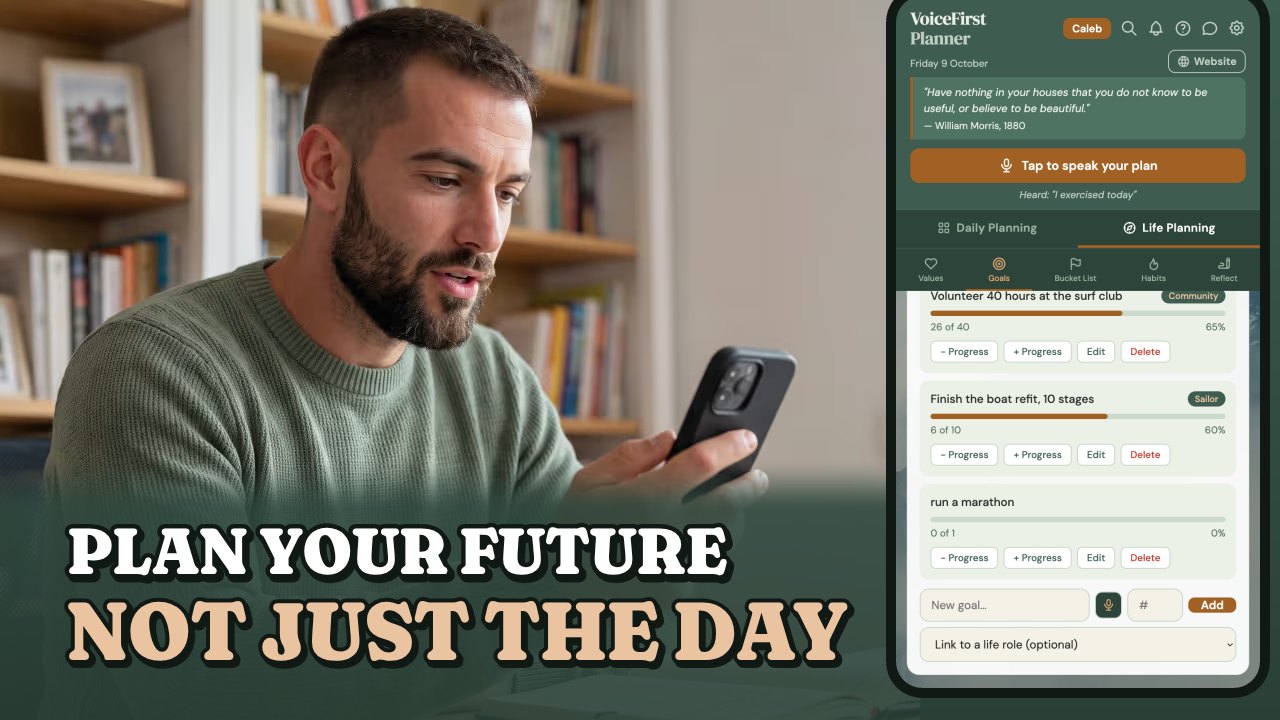
Shown on a paid plan. The free plan is a working planner, with limits.
Prefer YouTube? Watch it there ↗
This is why I built VoiceFirstPlanner so you can bring your work calendar in — and why I built it the way I did. You export a calendar file from Outlook, Google or Apple and bring it to your planner. Before a single meeting lands, the planner opens the door and shows you exactly what is asking to come in: every meeting listed, every one with a tick box, the pattern and the number of dates alongside each.
Untick the all-company meeting you have never once attended, and it stays outside. The count recalculates as you go. One button, and only what you chose is in your week.
One-way — nothing you do here ever changes your work calendar. No account connected, no permissions granted, nothing flowing back. Import again whenever you like; anything already there is skipped. Change your mind and one tap undoes the whole import.
Work asks. You decide.
Why I made it something you talk to
Because the moment a plan is worth capturing is almost never the moment you are sitting at a desk.
You have the good idea driving. You remember the thing you promised while you are walking to the car. You realise what actually matters halfway through a shower. And by the time you are somewhere you could type it, it is gone — not because you are disorganised, but because there was nowhere to put it.
So you tap the microphone and say it, and it lands where it belongs. That is the whole design. Everything else follows from it.
Work’s calendar, on your terms.
In this film
Work’s calendar comes in as a file, and you tick what enters. One-way — nothing you do here ever changes your work calendar.
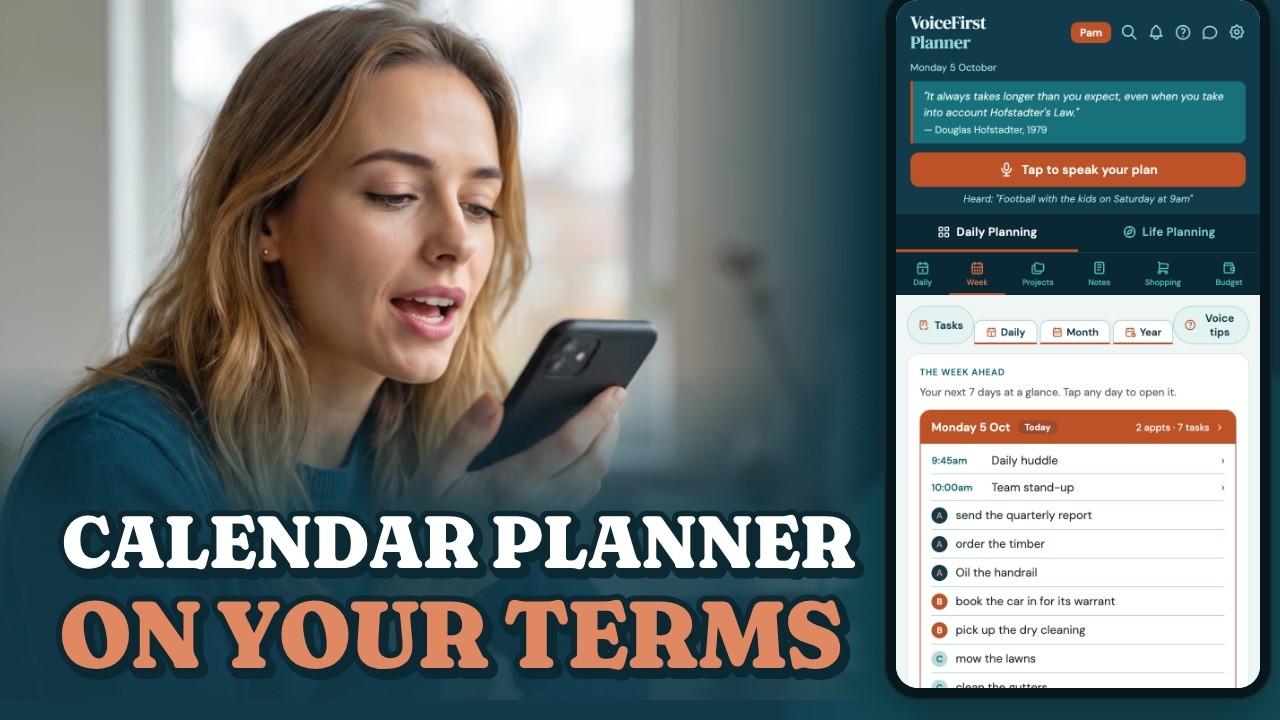
Shown on a paid plan. The free plan is a working planner, with limits.
Prefer YouTube? Watch it there ↗
The line I keep coming back to
I spent twenty years trying to rebuild, in a digital world, the organisation I used to have on paper. Twenty years of the same frustration: everything scattered, nothing joined up, the important things falling through.
What I eventually understood was not a technology problem. It was a category error. I was trying to run my life on tools designed for work, and being surprised when they did not fit.
The right tool for 40 hours is not the right tool for 168.
Your Day, your Week, your Month and your Year should play out the way you decide — not the way a work calendar dictates.
See the clash before Monday.
In this film
Sunday night: the week said out loud, the next seven days on one page, and a Wednesday clash moved before it happens.
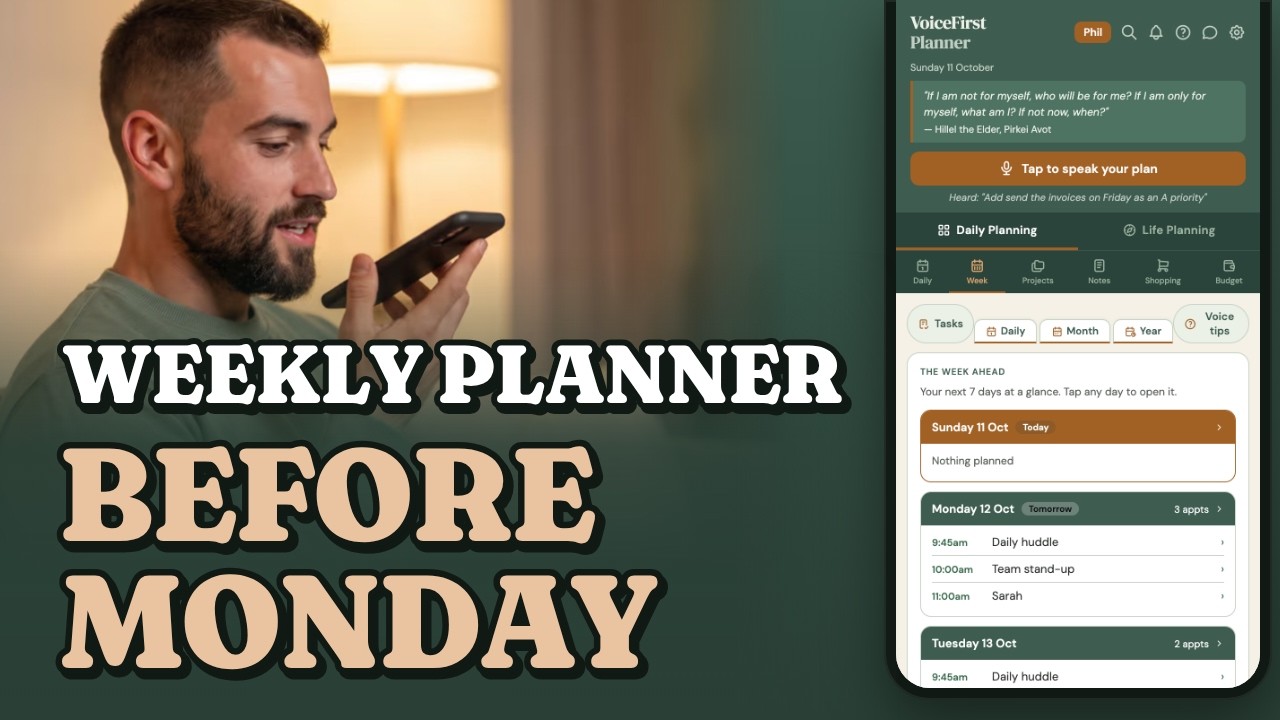
Shown on a paid plan. The free plan is a working planner, with limits.
Prefer YouTube? Watch it there ↗
A voice-first personal day planner. Just talk — your day plans itself.
Free to start. No card, no clock.
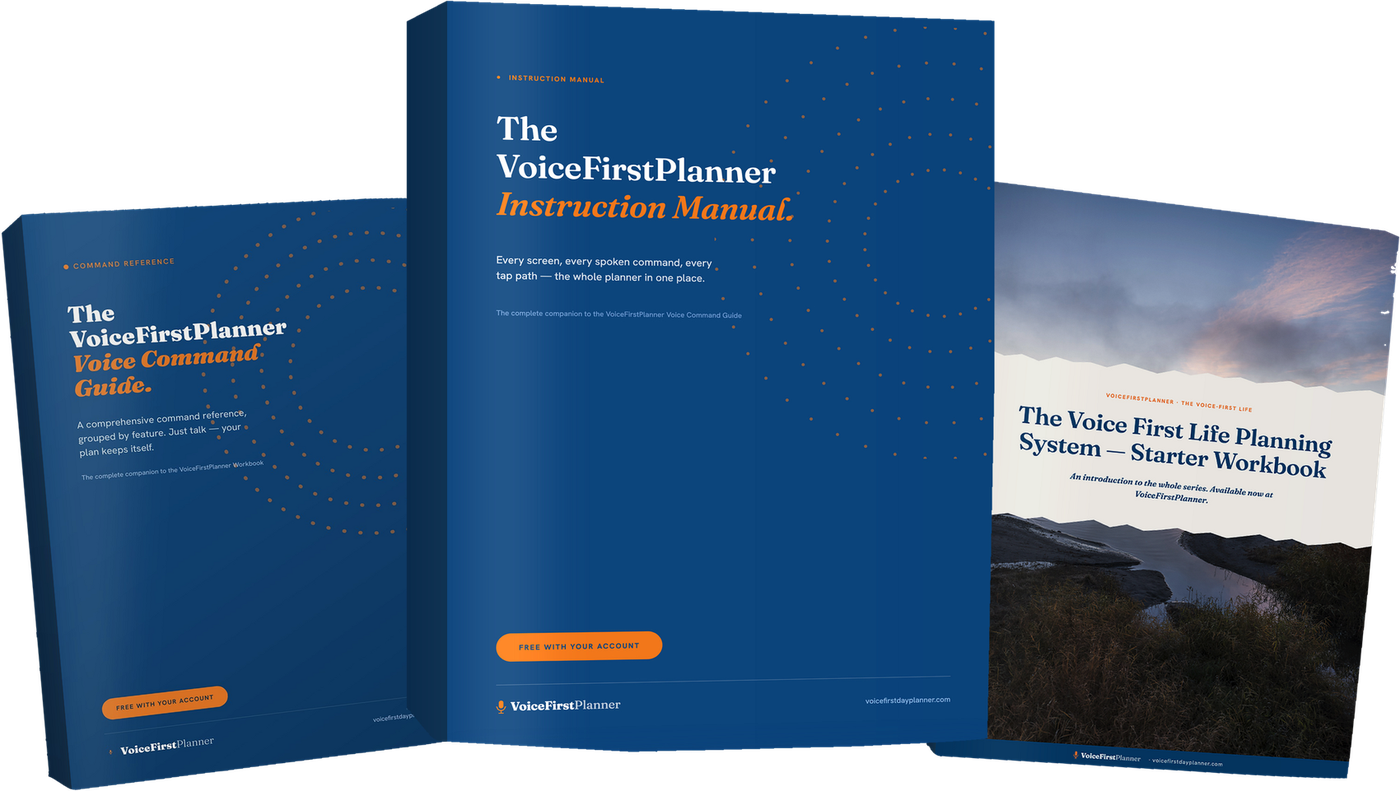
Three books. All free with your account.
The VoiceFirstPlanner Instruction Manual, The VoiceFirstPlanner Voice Command Guide and The Voice First Life Planning System — Starter Workbook.
$19.98 for the Starter Workbook alone — all three free when you create your free account.
Not sure where to go next?
Start here: eleven reasons on one page →