What voice-first planning is — and why it's faster than typing
Voice-first planning means using your voice as the primary way to capture, organize, and run your day, instead of sitting down to type. You speak what's on your mind — a task, an idea, an appointment — and your voice day planner sorts it into the right place. Typing is the fallback, not the starting point.
It works because speaking is how we already think. We form thoughts as sentences, not as taps on a keyboard. When an idea strikes — usually at the worst possible moment to stop and type — the quickest way to get it out of your head and safely into your plan is to say it out loud.
The speed gap is bigger than most people expect. In a 2016 study by researchers at Stanford, the University of Washington and Baidu, speaking text into a smartphone was about three times faster than typing it — and more accurate, too. When capturing a task by voice takes a third of the time, you actually do it in the moment, instead of promising yourself you'll "add it later" and forgetting by the time you could.
Five reasons voice planning beats typing every time
It's faster. As the Stanford research showed, speech is roughly three times quicker than thumb-typing — so capture keeps pace with your thinking instead of lagging behind it.
It's hands-free. You can plan on the commute, on a walk, while cooking dinner or carrying the shopping — the exact moments when good ideas arrive and a keyboard is nowhere in reach.
It's more natural. Spoken thoughts come out as whole sentences with context, not the clipped keywords you thumb into a box. "Call the client about the revised quote before Friday" carries far more than "call client."
It captures more. The ideas you lose are almost always the ones that arrived when typing was inconvenient. Lower the effort of capture and you simply catch more of them.
It reduces friction. Every extra step between a thought and your plan is a chance to lose it. Voice removes most of those steps, and the habit compounds: the easier capture is, the more you do it.
What you can plan by voice today
A voice planner is only useful if it handles a real day, not just a to-do list. With VoiceFirstPlanner you speak tasks and have them sorted into A, B, and C priorities, so the most important work rises to the top. You capture notes and ideas, set recurring appointments, and log a habit just by saying you did it. Your Projects hold voice notes, typed notes, and saved web links in one place — useful for a trade show, a renovation, or a launch — and anything you don't finish carries forward to the next day automatically, so nothing quietly disappears.
Today that capture is fast and rule-based — no AI required, which keeps it quick and predictable. AI voice interpretation and project summaries are coming with Pro. Everything above works in any browser, on the free plan, before you pay a cent.
How to plan your day by voice in five minutes
1. Set your daily focus. Name the one thing that would make today a success — not the most urgent thing, the most important one. Speak it as your focus and everything else lines up behind it.
2. Speak your tasks. Empty your head out loud: "add finish the client presentation as an A priority," "add call the supplier as a B," "add tidy the office as a C." Your list builds itself, already prioritized.
3. Log wins as they happen. Finished something? Say so and it's checked off. Went for a run? "I exercised today" marks the habit. No stopping, no typing.
4. Capture everything else. Stray ideas, notes, links and project thoughts all go straight to the right place, so your mind stays clear — nothing is stuck in it waiting to be written down.
5. Reflect in two minutes. At day's end, answer four short questions out loud: what went well, what to improve, what you're grateful for, and your intention for tomorrow. Small, but it compounds into real self-awareness.
Does a voice planner use AI?
Not today — and that's deliberate. Your voice is captured and organized by a fast, reliable system, so planning stays quick and dependable. AI voice interpretation, project summaries and a voice-activated focus timer are coming with Pro. If you want to compare what's free versus paid, the pricing page lays it out plainly.
Start planning by voice today.
Free to start. No credit card required. Works on any device, anywhere.
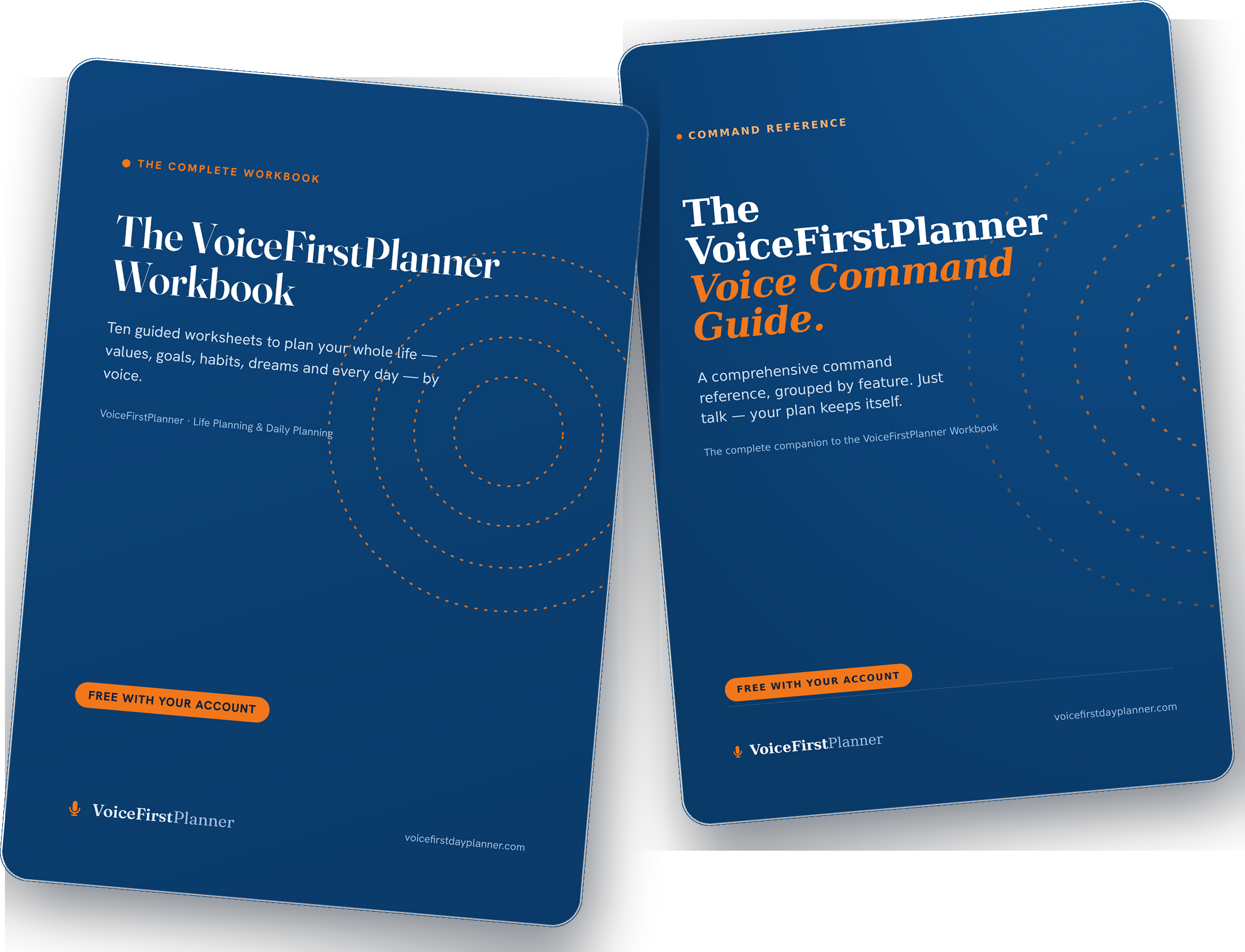
The complete VoiceFirstPlanner Workbook and Voice Command Guide.
Ten guided worksheets plus the full voice command reference — your whole plan, on paper and by voice. Both yours free the moment you create your free account.
$19.98 value — free when you create your free account.
Prefer just one? Every worksheet and command sheet is also a free download on its own page — no account needed.