What values-based planning is
Values-based planning is a simple idea with a big payoff: you put your personal values and life roles at the center of every planning decision. Instead of filling a calendar and hoping it adds up to a meaningful life, you define what a meaningful life looks like first, then build your days around that. The core principle is uncomfortable but true — if you don't consciously plan around your values, life will happily fill your time with other people's priorities instead.
It's the opposite of most productivity advice, which starts with your calendar and your inbox. Those tools are good at making you efficient. They're useless at telling you whether the things you're being efficient about actually matter to you.
Why start with values instead of your calendar
Because clarity changes behavior. There's good evidence that simply getting your intentions out of your head and onto the page makes you more likely to act on them. In a study at Dominican University of California, psychologist Gail Matthews found that people who wrote their goals down — and especially those who shared them and reported on their progress — achieved markedly more than those who only thought about them: roughly seven in ten of the most accountable group reported real progress, against about a third of those who kept their goals in their heads.
Values-based planning puts that finding to work. Once you've named what matters and written it down, the daily decisions get easier — because you already know what you're deciding for.
The four layers — from values to daily tasks
Layer one — your values. The handful of principles that guide your best decisions: family, integrity, growth, health, excellence. In a voice day planner built this way you define up to five, so you're forced to choose what truly counts.
Layer two — your life roles. Parent, professional, partner, friend, learner — each with its own quiet definition of success. Roles keep any one part of life from swallowing the rest.
Layer three — your long-term goals. Goals are values made concrete. If you value health, a goal might be a half-marathon; if you value growth, a dozen books this year. Each goal links back to a role.
Layer four — your daily tasks. This is where most planners start. Values-based planning makes it the last layer, not the first, because the right daily tasks flow naturally from the three above. Every A-priority task should trace back to something that genuinely matters.
How VoiceFirstPlanner builds it into every day
VoiceFirstPlanner is built on this exact structure. You define your values (up to five) and your roles, set goals linked to those roles, then connect each task to a goal and a role — all by voice — so your daily plan is always grounded in your bigger picture rather than floating free as a list of chores. Unfinished tasks carry forward automatically, so the things that matter don't slip off a date you'll never look at again.
Then comes the part the research says matters most: accountability. At the end of each day the reflection journal asks four short questions — including whether today actually reflected your values — so you're not just setting intentions, you're checking in on them. Over weeks, that loop is what turns a nice idea about intentional living into how you actually spend your time.
Start planning by voice today.
Free to start. No credit card required. Works on any device, anywhere.
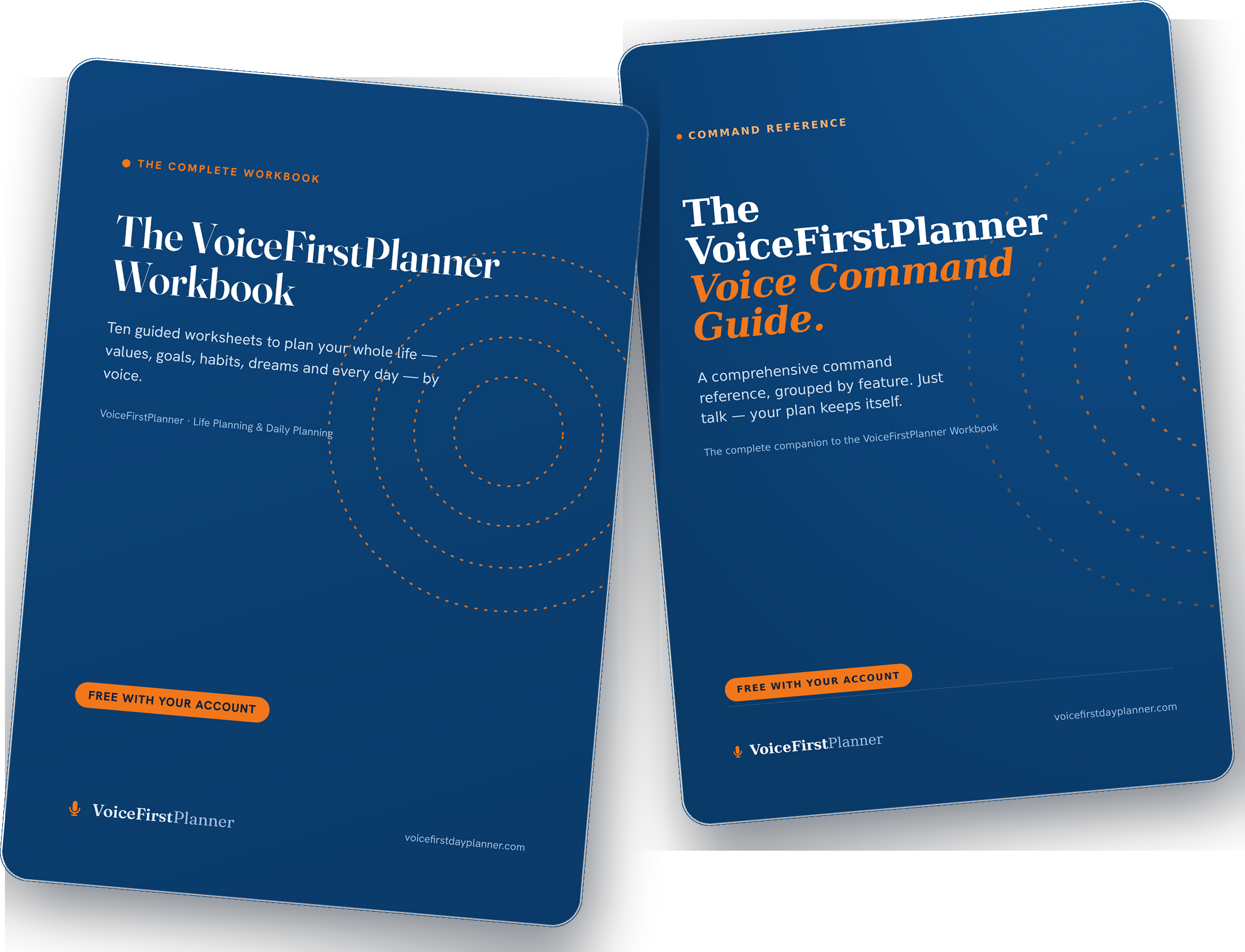
The complete VoiceFirstPlanner Workbook and Voice Command Guide.
Ten guided worksheets plus the full voice command reference — your whole plan, on paper and by voice. Both yours free the moment you create your free account.
$19.98 value — free when you create your free account.
Prefer just one? Every worksheet and command sheet is also a free download on its own page — no account needed.