A daily reflection journal: five minutes that change everything.
We don’t learn from experience — we learn from reflecting on experience. VoiceFirstPlanner’s reflection journal makes the daily and weekly check-in effortless: just talk.
The day ends and you can’t feel that anything actually moved.
You were busy. You know you were busy. But ask what changed and there is nothing to point at, because everything you finished disappeared the moment it was ticked.
Do that for a month and the effort starts to feel like a treadmill. Not because you achieved nothing — because nothing was ever banked.
“Another week gone, and I couldn’t tell you what was in it.”
“The same problem three times, and each time it was news to me.”
“I’d have good days and bad days and never look at why.”
“Somebody asked what I’d been up to and I genuinely couldn’t remember.”
What is a daily reflection journal?
A daily reflection journal is a few minutes at the end of the day spent on what happened and what it meant: what went well, what to change, what to carry into tomorrow. It is not a diary of events. It is the habit of noticing — and the entries add up into a record of what the days were actually for.
The answer
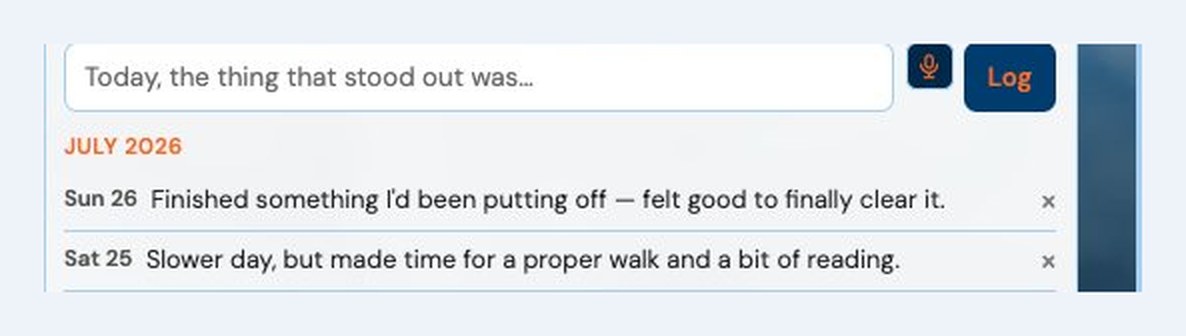
Say what went well. It takes a minute and it’s yours to keep.
Four questions, every evening. Speak the answers or type them. They save with the date, and they stay — so a month later you can look back at an ordinary Tuesday and see what you actually did with it.
The last question is the one that earns its place: what is tomorrow for? Answer it tonight and tomorrow starts already knowing.
“I did my morning reflection”
Logged. The habit’s marked for today.
Life Planning › Reflect
Where the four questions live, and every reflection you’ve saved.
Daily reflection is on the free plan.
What the research found
In an analysis of hundreds of workday diaries, nothing lifted motivation more than making progress in meaningful work.
Nearly twelve thousand end-of-day entries, from professionals across seven companies. Of everything that can happen in a working day, small visible progress in work that matters was the strongest lifter of mood and motivation — and setbacks drained it faster than anything else.
Progress you can see is the fuel. That is why the day gets banked rather than cleared.
What went well, what you would improve, what you are grateful for, and your intention for tomorrow. Four questions cover it.
How long should daily reflection take?
About two minutes. Doing it at the same time each day matters more than how long it takes.
Is there a reflection journal app?
VoiceFirstPlanner has a daily reflection journal built in: four questions each evening, answered by voice or typing, saved with the date. Daily reflection is on the free plan.
What are good self-reflection journal prompts?
Start with four: what went well today, what would you improve, what are you grateful for, and what is your intention for tomorrow. More are on this page.
End the day knowing what it was for.
Free account. No card, no clock. Your reflection journal sits in Life Planning, in the same app as your daily planner.