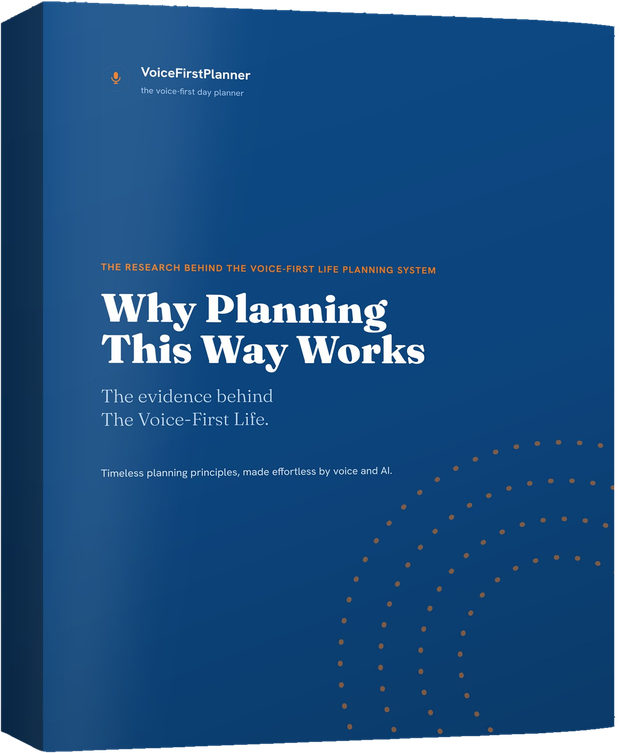
This page is the evidence. Seven settled findings, 15 to 27 years old, explain why planning this way works — and why doing it by voice removes the exact friction that trips most people up. With VoiceFirstPlanner, the voice-first day planner, the wisdom is old; the interface is new.
Seven findings explain why planning this way works — and why doing it by voice removes the exact friction that trips most people up. Each one is stated in full below; the paper is where the sources sit.
A task with no moment attached is a hope, not a plan.
Most planners give you a list and a due date; the real question — when and where will I actually do this — is left to you.
You say it with a time and a place — “gym at six, before work” — and your day fills with real slots, not a floating list.
Across 94 studies, deciding when and where you’ll act had a medium-to-large effect on whether people actually followed through.
Every extra choice is a small tax on willpower; enough of them and the easiest option becomes doing nothing.
Most planners hand you infinite flexibility and a blank canvas — you tune a system instead of using it.
One Daily Focus. Speak it. Done. The next choice stays small on purpose.
In the famous jam study, shoppers were far more likely to buy when shown six options instead of twenty-four. Less choice, more action.
Vague goals give your mind nothing to lock onto; “more,” “better,” “someday” quietly become not today.
Most planners store a wish-list — somedays with no edge and no owner.
You name a specific goal tied to a role — “as a dad, take Friday afternoons off by June.” Specific, dated, yours.
Across 35 years of research, specific and challenging goals consistently beat “do your best.”
Motivation runs on visible progress; without it, effort feels like a treadmill and drains away.
Most planners give you a checkbox and little else — no arc, no place for the win to land.
Every project has a next action, unfinished items carry forward, and a spoken reflection banks the day’s win where you can see it.
In an analysis of hundreds of workday diaries, nothing lifted motivation more than making progress in meaningful work.
Open loops don’t wait politely; unfinished tasks crowd out everything, including rest.
Most planners let you capture tasks — but a pile of captures isn’t a plan, and your mind knows the difference.
You speak the actual plan — what, when, where — and your mind is finally allowed to let go.
Unfinished goals keep intruding on your thoughts — but making a specific plan makes that interference disappear.
Some goals are yours. Others you picked up from someone else — a parent, a boss, a feed. Both take the same effort. Only one of them is worth reaching.
Most treat every goal as equal cargo; they will happily store a life’s worth of ambitions you never actually chose.
You name your values and your roles first, and goals attach to them: “as a dad,” “as a builder.” The planner asks who you are before it asks what you’ll do.
Goals rooted in your own values drew more sustained effort and were reached more often — and reaching them genuinely improved well-being. Borrowed goals didn’t.
Most habit tracking runs on streaks. Miss a day and the number resets, which turns one ordinary human lapse into a reason to stop altogether.
Many make the streak the point: chains you mustn’t break, counters back to zero, a small punishment for being a person.
Say it in the past tense — “I exercised today” — and today fills in. There is no guilt mechanic, no reset to zero, no shame streak. You pick it up tomorrow.
Habits grew from repeating a behavior in a consistent daily context — and missing a single day did not materially affect the process.
The findings above are the whole claim, stated plainly. The paper is where all seven studies are written up in full — and where every source is checked live, with the citation and a link to read it yourself.
Or get it free. The paper is included with Premium Annual, Pro Annual and Lifetime — along with the app.
The full paper: seven findings written up, the comparison, and every source with its citation and a link to read it yourself.
$44.95 for the paper — or $2.93 more gets it free, plus the whole system: a year of the app, the Starter Books, and the Values, Goals & Habits workbooks. $169.78 of value for $47.88.
Also included with Pro Annual and Lifetime — Lifetime is Premium for life, all eight workbooks, and this paper, for $99 once.
“when you’re organized, the stress goes out of your day.”
The research says the same thing seven ways: decide the when and where, keep choices small, make goals specific, protect your sense of progress, get the plan out of your head, make sure the goals are actually yours, and let a missed day be just a missed day. The paper shows the evidence; the app makes it effortless.
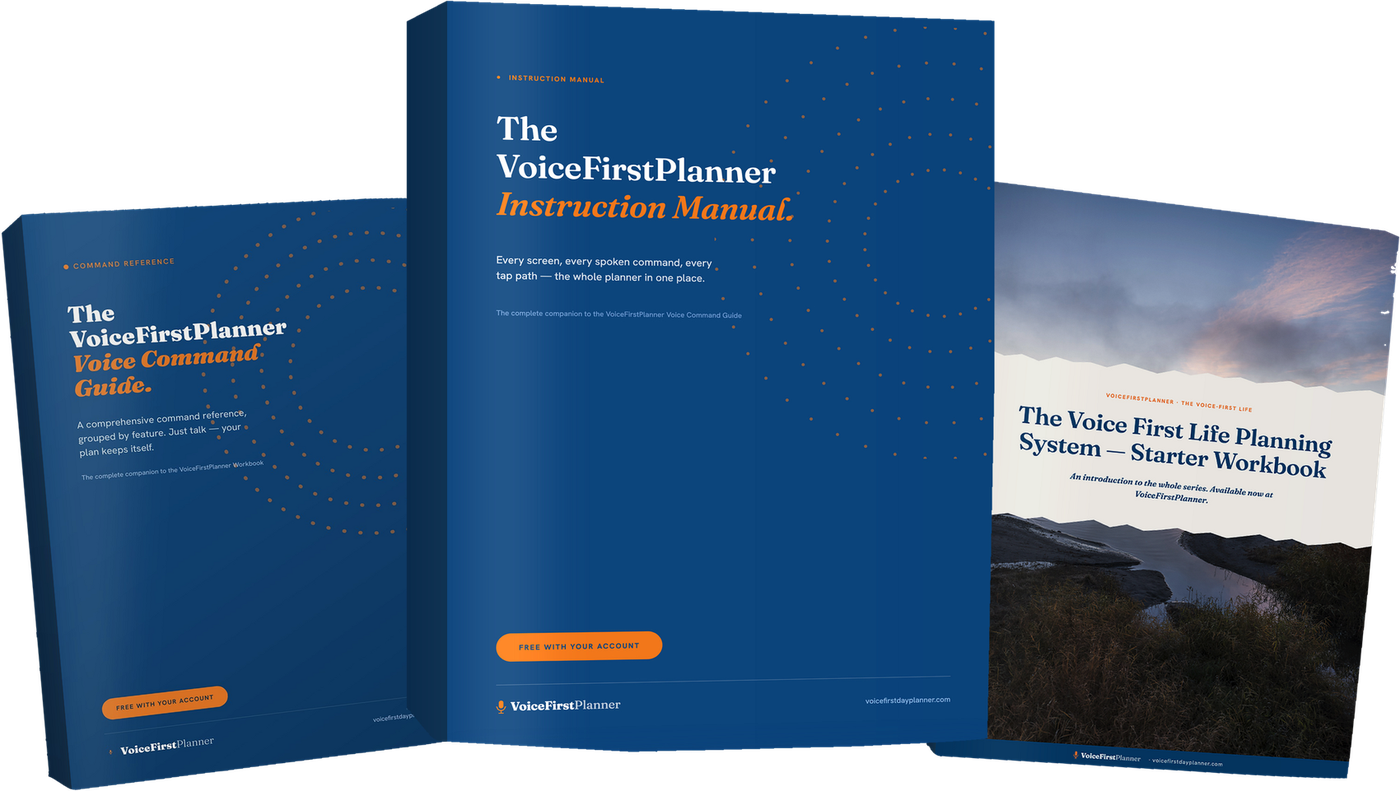
The workbook teaches the method on paper. The app runs it by voice. Speak your tasks, appointments, goals and notes; they sort themselves.
Free account. No card. Because when you’re organized, the stress goes out of your day.